
Cooling multiple rooms with one air conditioner (AC) may seem impossible, but with smart planning, it is very achievable. Many homeowners and renters face this challenge, especially in homes or apartments where installing several AC units is not practical or affordable.
Whether you have a strong window unit, a portable AC, or a split system, you can stretch its cooling reach to cover more rooms. This guide explores proven strategies, tips, and common mistakes to help you make the most of your AC and keep your whole home comfortable.
Understanding The Challenge
One AC is designed to cool a certain space, often measured in square feet. When you ask it to cool more rooms, you push its limits. The cool air needs to travel, and warm air from other rooms can sneak in. Before exploring solutions, know your AC’s capacity (measured in BTUs, or British Thermal Units). A small unit for a large area will struggle and cost more in electricity without giving good results.
For example, a 10,000 BTU unit can usually handle a single 400–450 sq ft room. If you want to cool two or three rooms, you need clever ways to help the cool air move, block heat from outside, and avoid common mistakes.
Choose The Right Ac For Multiple Rooms
If you haven’t bought an AC yet, or plan to upgrade, you can save energy and money by choosing wisely.
Size And Btu Rating
Check the BTU rating of your AC. Higher BTU means more cooling power, but too high can waste energy and cause humidity problems. For multiple rooms, add up the square footage and use an online calculator or this simple guide:
- 300–500 sq ft: 8,000–12,000 BTU
- 500–800 sq ft: 12,000–18,000 BTU
- 800–1200 sq ft: 18,000–24,000 BTU
But remember, layout matters. If rooms are open to each other, air moves easier. If they are separated by walls, it is harder.
Type Of Ac
Some ACs are better for cooling more than one room:
- Ductless mini-split: One outdoor unit can connect to several indoor units. You control each room’s temperature. It’s more expensive upfront but very efficient.
- Portable AC: Easy to move. You can place it near doorways or hallways to cool more space.
- Window AC: Fixed in one room but can help cool others if you follow certain tricks.
Central air systems cool whole houses but need ducts in the walls—many older homes do not have these.
Maximize Airflow Between Rooms
If you already have a strong AC in one room, the secret is to help the cool air travel to other areas.
Open Doors Strategically
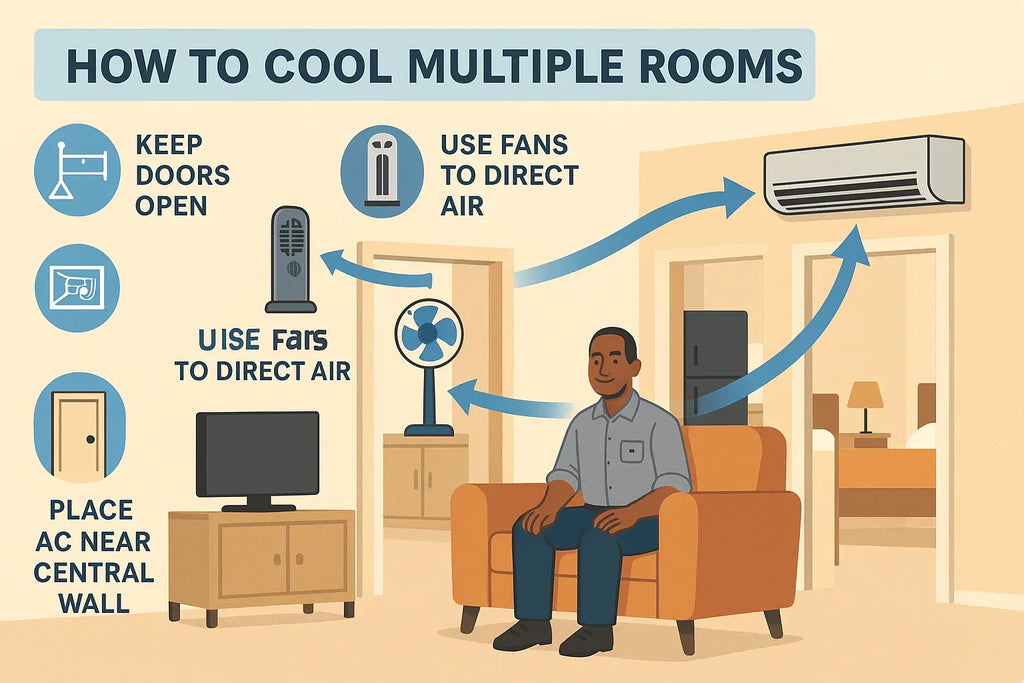
- Keep interior doors open when possible. This lets cool air move from the AC room to others.
- For faster cooling, open doors in the path you want air to go, and close unused rooms.
Use Fans To Move Air
Fans are your best friends here:
- Box or floor fans: Place a fan in the doorway, blowing cool air into the next room. If you have several fans, use one to push cool air out and another to pull it in the direction you want.
- Ceiling fans: Run them in a counterclockwise direction during summer. They don’t lower air temperature but create a wind-chill effect that feels cooler.
Non-obvious tip: Turn on bathroom or kitchen exhaust fans for a few minutes. They can pull hot air out and help draw cool air further into the house.
Air Vents And Grilles
If your home has air return vents (usually found high on walls), make sure they are not blocked. They help air move back toward the AC, creating a loop. In homes without central air, you can install transfer grilles (small vents above doors or in walls) to let air move more easily between rooms.
Diy Ducts And Air Paths
For some homes, you can use flexible ducts or even large pipes to direct cool air from the AC room to others. These can look temporary but are effective for workshops or garages.
Zone Cooling: Focus On Occupied Spaces
Zone cooling means focusing the cool air on rooms you actually use.
- Close doors to unused rooms—this keeps cool air where you want it.
- Use door draft stoppers or towels at the bottom of doors to block hot air from seeping in.
- If your AC has a swing or louver feature, angle the air output toward hallways or doors, not just the center of one room.
This method saves energy and makes cooling more efficient, since you’re not trying to cool the whole house at once.
Block Heat From Outside
Every bit of heat you block means less work for your AC.
Insulate Windows And Doors
- Use thermal curtains or blackout shades to keep sunlight out during the day.
- Seal gaps around windows and doors with weatherstripping.
- For windows that get a lot of sun, put reflective film or cardboard on the outside.
Shade And Coverings
- Plant trees or install awnings to shade windows.
- If your AC is in a sunny room, add shade outside—this can lower indoor temperatures by several degrees.
Insight: Even a small gap under a door lets in hot air. Sealing these can make a big difference for multi-room cooling.
Use Smart Controls And Timers
Modern ACs often have smart thermostats or timers. You can set them to cool at certain times, or adjust the temperature based on when you are home.
- Program the AC to turn on before you arrive, so rooms are cool when you need them.
- Use a remote temperature sensor (if available) in the room farthest from the AC. This helps the system keep that room comfortable, not just the AC room.
Non-obvious tip: Some smart plugs let you control fans and ACs with your phone, so you can turn them on or off from anywhere.
Compare Cooling Strategies
It helps to see how different methods stack up. Here’s a comparison:
| Method | Cost | Energy Use | Best For | Drawback |
|---|---|---|---|---|
| Open doors + fans | Low | Low | Small to medium homes | Less control |
| Mini-split system | High (setup) | Very efficient | Multiple rooms, upgrades | Upfront cost |
| Portable AC in hall | Medium | Medium | Apartments, rentals | Loud, needs venting |
| Window AC + transfer grilles | Low to medium | Medium | Older homes | DIY skills needed |
Real-world Example: Cooling A 3-room Apartment
Let’s say you have a 12,000 BTU window AC in the living room, and you want to cool your living room, kitchen, and bedroom (total 700 sq ft).
- Keep all doors open between these rooms.
- Place a box fan in the bedroom doorway, pulling cool air in.
- Close the bathroom and closet doors.
- Hang blackout curtains in all rooms to block sun.
- Seal cracks around windows.
- Set the AC to its highest fan speed during the hottest part of the day.
- In the evening, turn on exhaust fans to push out hot air.
By following these steps, you can keep all three rooms comfortable—even during a heatwave—without buying a second AC.
Mistakes To Avoid
Beginners often miss these:
- Oversizing the AC: Buying a unit that’s too large wastes energy. It cools the air fast but leaves humidity, making rooms feel damp.
- Ignoring airflow: If doors are closed or blocked, cool air never reaches other rooms.
- Blocking return vents: Placing furniture in front of vents stops air circulation.
- Not sealing leaks: Hot air sneaks in through gaps, making your AC work harder.
- Wrong fan direction: Fans blowing the wrong way can pull hot air from other rooms instead of pushing cool air where you want it.
Pro tip: Don’t set your AC to the coldest setting thinking it will cool faster. It only makes the unit run longer, not more efficiently.
Energy Efficiency Tips
Cooling multiple rooms with one AC can use more power if you’re not careful. Here’s how to keep bills down:
- Raise the temperature a few degrees when you’re not home.
- Clean or replace AC filters monthly—dirty filters block airflow.
- Use fans to spread cool air instead of lowering the thermostat.
- Unplug electronics and lights in unused rooms; these add heat.
- If possible, run the AC during off-peak electricity hours (usually early morning or evening).
Fact: Every degree higher on your thermostat can cut cooling costs by 3–5%.
When To Upgrade Or Add Another Ac
Sometimes one AC isn’t enough, especially in large homes or extreme climates. Signs you may need another unit:
- Some rooms never get cool, no matter what you do.
- The AC runs nonstop but can’t keep up.
- Your energy bills are very high.
If your AC is old (over 10 years), it may be less efficient. Newer models use less energy and cool more evenly. You can learn more about energy-saving ACs at the Energy Star website.
Portable Vs. Window Vs. Split Systems
Not sure which AC is best for multi-room cooling? Here’s a side-by-side look:
| Type | Install Difficulty | Mobility | Noise Level | Multi-Room Use |
|---|---|---|---|---|
| Portable AC | Easy | High | Medium to High | Good (with fans) |
| Window AC | Medium | Low | Medium | Fair (needs airflow help) |
| Mini-Split | High | Fixed | Low | Excellent (with multiple heads) |
Maintenance For Best Performance
Regular care keeps your AC running strong and efficient:
- Clean filters: Every 2–4 weeks during heavy use.
- Check coils: Dust and dirt reduce cooling power.
- Inspect seals: Replace weatherstripping each year.
- Clear vents: Move furniture away from air paths.
Neglecting maintenance can cut cooling capacity by 10–15%.
Smart Home Upgrades
If you like tech, smart home tools can make cooling easier:
- Smart thermostats learn your habits and cool rooms at the right times.
- Smart fans can be set to turn on when the AC runs, moving cool air automatically.
- Room sensors: These measure temperature in each room and adjust cooling to match.
These upgrades can cost more upfront but save money in the long run by avoiding wasted energy.
Credit: thesun.my
Diy Vs. Professional Solutions
Some fixes are easy to do yourself, like adding fans or sealing leaks. Others, like installing transfer grilles or mini-splits, need more skill. If in doubt, call a pro—especially for electrical work or wall cutting.
How To Test Your Multi-room Cooling
After setting up your system, check if it works:
- Place a thermometer in each room.
- Run the AC and fans for 30 minutes.
- Compare temperatures. If one room is much warmer, adjust fan placement or door positions.
- Repeat until all rooms are within 3–5 degrees of each other.
Tip: Sometimes, moving a fan just a few feet makes a big difference.

Credit: deepchill.com.au
Cost Breakdown
Here’s what you might spend on different solutions:
| Item | One-Time Cost | Annual Energy Cost* | Notes |
|---|---|---|---|
| Box fan | $20–$50 | $10–$20 | Use in doorways |
| Transfer grille | $25–$60 | $0 | DIY install possible |
| Mini-split (single head) | $1,000–$2,500 | $50–$120 | Very efficient |
| Portable AC | $300–$700 | $80–$200 | Needs venting |
| Window AC | $150–$600 | $60–$180 | Best for small homes |
*Estimates based on average US electricity rates.
Practical Tips For Every Home
- Always run the AC on “high” at first, then lower the fan speed once the rooms are cool.
- Rearrange furniture so cool air can flow freely between rooms.
- Hang a wet sheet in a doorway for a quick, temporary cooling boost—evaporation cools air as it passes through.
- Avoid using the stove or oven during the hottest part of the day.
- Try to cool rooms at night when outside air is cooler—open windows if safe.

Credit: www.youtube.com
Frequently Asked Questions
Can I Cool Two Rooms With One Window Ac?
Yes, if the rooms are connected (like a bedroom and living room), you can cool both by keeping the door open and using a fan to move air. You may not get the same temperature in both rooms, but it will be much cooler than with no AC.
Does Putting Fans In Windows Help Cool The Whole House?
Fans can help if used the right way. Put a fan facing out in one window (to push hot air out) and another facing in (to pull cool air in) on the opposite side. This creates airflow through the house.
Is A Portable Ac Better Than A Window Ac For Multiple Rooms?
Portable ACs are easier to move and can cool different rooms at different times. But they are often less efficient and noisier than window units. For cooling many rooms at once, window ACs with fans usually work better.
How Can I Tell If My Ac Is Too Small For My Home?
If your AC runs all the time and rooms still feel warm, or if you see high humidity and little temperature change, your AC may be too small. Try adding fans and blocking heat first. If that doesn’t help, a larger unit may be needed.
Is It Safe To Run An Ac And Fans Together?
Yes, running fans with your AC is safe and helps spread cool air more evenly. Just make sure cords are not overloaded and fans are placed safely out of walkways.
Cooling multiple rooms with one AC is not just possible—it’s practical with the right plan. By understanding airflow, blocking heat, and using smart tools, you can stay comfortable all summer without breaking the bank. Each home is unique, so experiment with these strategies and see what works best for your space.
With a bit of creativity and care, you can beat the heat—room by room.