
Butane Vs Propane: A Complete Comparison For Everyday Use
Choosing the right fuel can make a big difference in your daily life, whether you are camping, grilling, or heating your home. Many people wonder about the real differences between butane and propane. Both are common types of liquefied petroleum gas (LPG) and look similar, but they have important differences that affect performance, safety, storage, and cost. If you have ever been unsure which one to use, you’re not alone. Understanding butane vs propane can help you save money, stay safer, and pick the best option for your needs.
This guide explains everything you need to know. You will learn how butane and propane are made, how they work, and which situations suit each fuel best. We will dig into technical details, practical advice, and real-world examples. By the end, you’ll have a clear answer to the butane vs propane question, and you will be able to make confident choices for work, travel, and home.
What Are Butane And Propane?
Butane and propane are both hydrocarbon gases. They come from natural gas processing and crude oil refining. While their chemical formulas are similar, their properties and uses vary.
- Butane: The chemical formula is C4H10. At room temperature, it is a gas, but it becomes a liquid under moderate pressure.
- Propane: The chemical formula is C3H8. It is also a gas at room temperature but turns to liquid under higher pressure than butane.
Both fuels are colorless and odorless in their pure form. A strong-smelling additive called mercaptan is added so leaks can be detected.
Key Point: Both are widely used for heating, cooking, and as fuel for portable devices, but their performance depends on conditions.
How Are They Produced?
The production process for butane and propane is very similar. Both are separated from crude oil and natural gas at refineries.
- Extraction: Natural gas wells and oil fields produce raw gas mixtures containing many hydrocarbons.
- Separation: Refining plants use cooling and pressure to separate propane, butane, and other gases from methane (main natural gas).
- Purification: The gases are cleaned to remove impurities and water.
- Bottling: The purified gases are stored in pressurized tanks for transport and sale.
Butane and propane often come mixed together in LPG cylinders, but they are also sold separately for specialized uses.
Credit: www.pinnaclepropane.com
Chemical Properties And Technical Differences
While butane and propane are similar, their chemical properties create important differences in how they behave.
| Property | Butane (C4H10) | Propane (C3H8) |
|---|---|---|
| Boiling Point | 31°F (-0.5°C) | -44°F (-42°C) |
| Vapor Pressure (at 70°F) | 16 psi | 110 psi |
| Energy Content (per gallon) | 102,000 BTU | 91,500 BTU |
| Density (liquid form) | 2.48 lb/gal | 4.23 lb/gal |
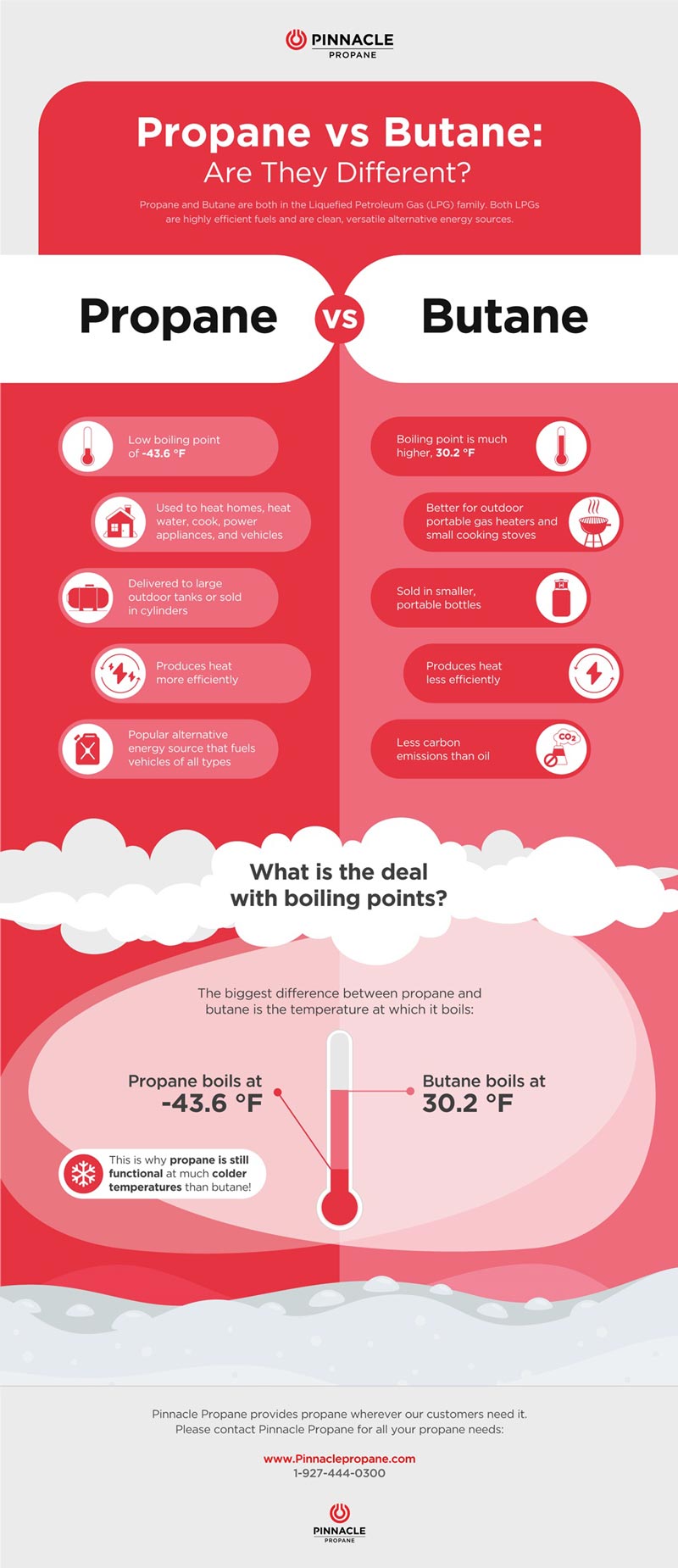
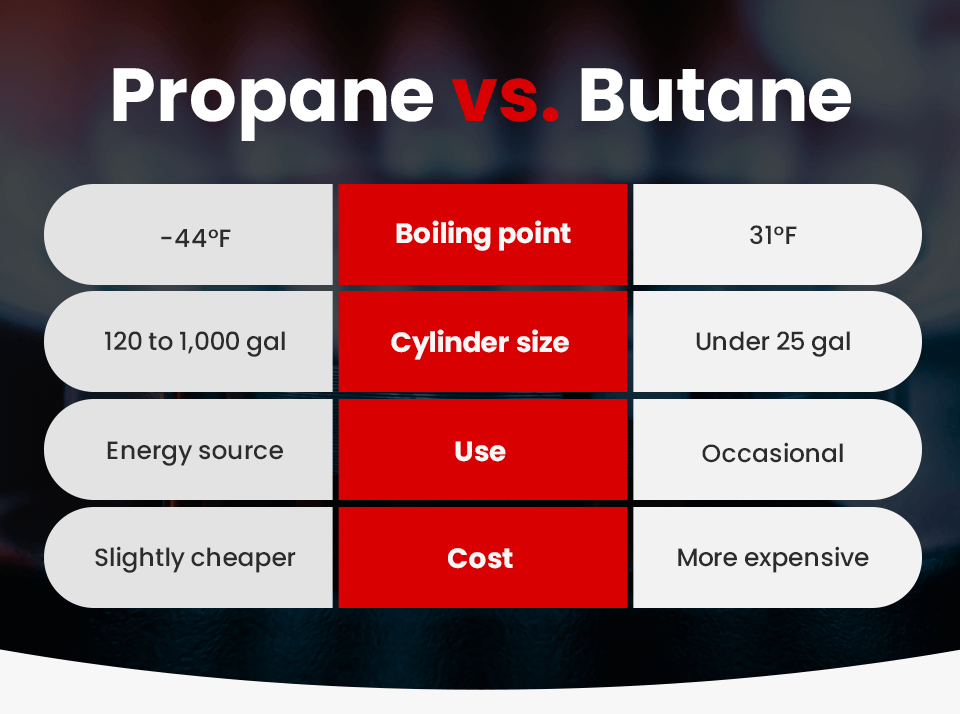
Non-obvious insight: The much lower boiling point of propane is key. It means propane stays as a gas at much colder temperatures than butane.
Storage And Transportation
Storing and transporting butane and propane is easy, but some differences can impact your choice.
- Propane cylinders are designed to handle high pressures. They are usually made of thick steel or aluminum and have strong safety valves. Propane tanks can be left outside in cold weather without risk of losing gas pressure.
- Butane cylinders require less pressure and are often lighter and more portable. However, butane can stop flowing in cold weather because it liquefies at temperatures just above freezing.
Common Container Sizes
Both fuels are available in several sizes:
- Small Canisters: 4–8 oz (portable stoves, lighters)
- Camping Bottles: 16 oz to 1 lb (backpacking, portable grills)
- Household Cylinders: 5–20 lb (grills, patio heaters)
- Larger Tanks: 100 lb or more (home heating, industrial use)
Tip: Never refill a butane or propane container with the wrong gas. Each container is designed for its specific pressure.
How Butane And Propane Are Used
Both fuels are popular, but their best uses are not always the same. Here’s where each one shines.
Butane
Butane is common for:
- Portable camping stoves (especially in warm weather)
- Cigarette lighters and small torches
- Some portable heaters
- Blowtorches for cooking (e.g., caramelizing sugar)
It is valued for clean burning and a steady flame. Butane cartridges are light and easy to carry. However, butane does not work well at temperatures near or below freezing.
Propane
Propane is used for:
- Barbecue grills
- Home heating systems
- Large space heaters
- RVs and campers
- Forklifts and industrial equipment
Propane performs reliably in very cold weather. That is why it is the top choice for outdoor use in winter or mountain climates.
Non-obvious insight: Many “universal” camping gas canisters actually contain a blend of butane and propane, combining the best features of both for better performance in all seasons.
Efficiency And Energy Output
You might be surprised to learn that butane contains more energy per gallon than propane. However, propane has a higher vapor pressure, which means it vaporizes and burns more easily, especially in the cold.
- Butane: 102,000 BTU/gallon
- Propane: 91,500 BTU/gallon
But in practice, propane is more efficient in cold weather because it stays gaseous and delivers fuel when butane would stay liquid and not flow.
Practical example: If you use a butane stove on a freezing morning, you may see a weak flame or no flame at all. A propane stove will keep burning strong.
Performance In Different Temperatures
Temperature is the most important factor when deciding between butane and propane.
| Temperature | Butane Performance | Propane Performance |
|---|---|---|
| Above 32°F (0°C) | Works well | Works well |
| 20°F to 32°F (-6°C to 0°C) | Weak output | Works well |
| Below 20°F (-6°C) | May not work | Works well |
| Below -44°F (-42°C) | Does not vaporize | Does not vaporize |
Key takeaway: For winter camping or emergency heating, always choose propane over butane.
Safety And Handling
Butane and propane are both safe when handled properly, but each has its own risks.
Butane Safety
- Leaks are harder to detect in cold weather, as butane stays liquid
- Canisters are easy to carry, but more fragile than propane tanks
- Butane is heavier than air, so leaked gas collects at low points (like basement floors)
Propane Safety
- High pressure means tanks must be properly maintained and stored upright
- Propane is also heavier than air, so it can collect and form a fire risk if leaked indoors
- Most household accidents come from old or damaged hoses, not the gas itself
Tips for both gases:
- Store cylinders outside or in well-ventilated places.
- Check hoses and valves for leaks regularly (use soapy water—bubbles show a leak).
- Never use these gases in unventilated rooms.
- Keep flames and sparks away from leaking gas.
Common beginner mistake: Many people do not realize that small leaks, especially indoors, can quickly reach dangerous levels. Always ensure valves are closed tight after use.
Cost And Availability
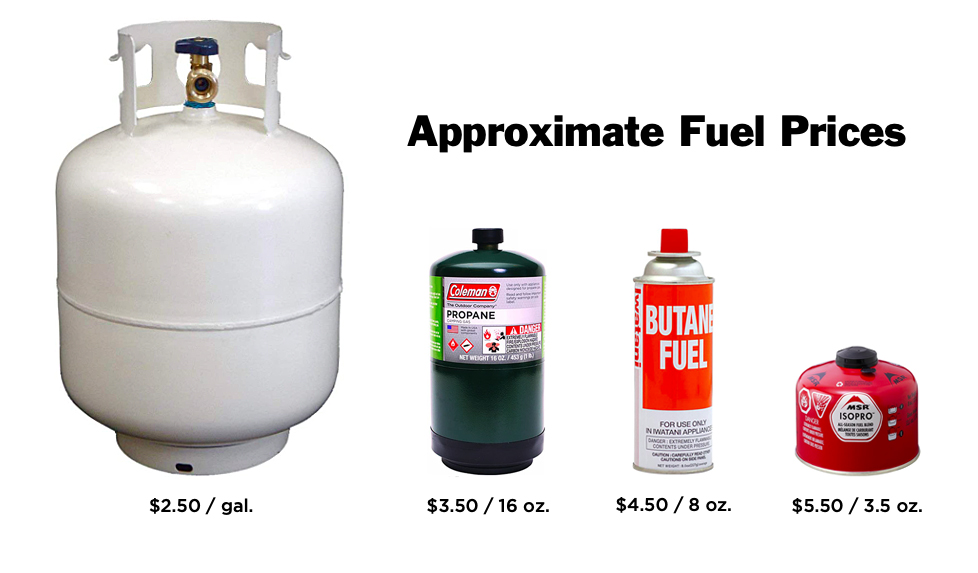
Propane is usually cheaper and more widely available in the United States. You can buy or exchange propane tanks at hardware stores, supermarkets, and gas stations.
Butane is often more expensive and may be harder to find, especially in rural areas. It is most often sold in small canisters for lighters, portable stoves, and specialty uses.
Why is propane cheaper? Propane is produced in larger quantities as a byproduct of natural gas processing, while butane is more limited.
Practical tip: If you want to save money on fuel for grilling or heating, propane is usually the better choice.
Environmental Impact
Both butane and propane are considered clean-burning fuels, especially compared to coal, gasoline, or kerosene. They produce mostly carbon dioxide and water when burned.
- Propane creates slightly less carbon dioxide per BTU than butane.
- Neither fuel contains sulfur or lead.
- Both can spill without polluting soil or water, as they evaporate quickly.
However, both are still fossil fuels, so they contribute to global CO2 emissions when used in large amounts.
Non-obvious insight: Some companies now offer “bio-propane,” made from renewable sources, but it is not widely available.
Credit: cheaprvliving.com
How To Choose: Butane Vs Propane For Common Uses
Let’s look at common real-world situations and which fuel is usually better.
Camping And Backpacking
- Summer camping: Butane is fine and is lighter to carry.
- Winter or high-altitude: Propane is essential, as it works in low temperatures.
- Long trips: Propane tanks are easier to refill or exchange.
Home Heating
- Permanent home heating: Propane is the standard. Tanks can be large and refilled by delivery trucks.
- Small heaters: Butane can work indoors, but only in well-ventilated areas.
Grilling And Outdoor Cooking
- Propane is the top choice for backyard grills due to price, power, and availability.
- Butane can be used for portable picnic stoves.
Lighters And Torches
- Butane is the fuel for cigarette lighters, kitchen torches, and small flame devices because it produces a smooth, clean flame.
- Propane is better for larger torches and outdoor use.
Emergency Preparedness
- Propane is a better emergency fuel, especially if you live in a cold region.
Key advice: If you live somewhere with cold winters, always keep propane on hand for backup heating or cooking.
Can You Mix Butane And Propane?
Many camping gas canisters use a butane-propane blend. This combines the easy ignition of butane with the cold-weather performance of propane. The mix ratio changes by brand and season—winter blends have more propane.
Important: Never try to mix gases yourself. Use only factory-sealed, labeled canisters. Mixing at home is dangerous and can cause leaks or explosions.
Non-obvious insight: Even small changes in the butane-propane ratio can affect how well your stove or heater works in the cold.
Credit: fosterfuels.com
Refilling And Reusing Cylinders
Refilling propane tanks is common and safe if done at licensed stations. Many people exchange their empty tanks for full ones.
Butane canisters are usually disposable, but some refillable models exist. Never try to refill a disposable butane canister—it is not designed to withstand repeated pressurization and could burst.
Beginner mistake: Trying to refill small butane lighters or canisters with the wrong adapter can cause leaks or damage.
Regulations And Standards
Both butane and propane must meet government safety standards in the US and most countries.
- Propane tanks have date codes, inspection requirements, and must be recertified or replaced after a certain number of years (usually 12).
- Butane canisters are labeled for use with certain devices and must not be exposed to high heat.
Always read and follow the instructions for your specific container and device.
Myths And Common Misunderstandings
Myth 1: “Propane is more dangerous because it’s at higher pressure.”
- Fact: Both gases are safe if handled properly. Most accidents are due to user error, not the gas itself.
Myth 2: “Butane is always better because it has more energy.”
- Fact: In cold weather, propane is far superior because it vaporizes even in low temperatures.
Myth 3: “You can use any gas in any device.”
- Fact: Devices are designed for a specific fuel and pressure. Using the wrong gas can cause leaks, weak flames, or explosions.
Non-obvious insight: Some portable stoves sold as “butane” units will NOT work with pure propane, even if the canister fits. Always check the label.
Worldwide Use And Trends
In North America, propane is the dominant LPG for heating, BBQs, and RVs. In Europe and Asia, butane is more common in small portable stoves and indoor appliances.
Fun fact: In the UK, “Calor Gas” refers to both butane and propane sold by the same company, but blue bottles are butane, and red bottles are propane.
Emerging trend: More people are using LPG blends for outdoor activities, as they work reliably in all seasons.
External resource: For more details on the chemistry and safety of LPG gases, see the Liquefied petroleum gas Wikipedia page.
Practical Tips For Choosing And Using Butane Or Propane
- Read your device manual. Use only the fuel type it recommends.
- Store your cylinders safely. Keep them upright, outside, and away from heat or flames.
- Check for leaks. Use soapy water around valves and hoses—bubbles show a leak.
- Use the right size. For a weekend trip, a small canister is fine. For home heat, you need a larger tank.
- Plan for temperature. If it might drop near freezing, always choose propane or a propane-rich blend.
- Dispose of empty cylinders correctly. Never throw them in household trash; many stores offer recycling or exchange programs.
- Never modify containers. Do not try to refill, repair, or change valves unless you are trained and have the right equipment.
Non-obvious insight: Always check the cylinder’s expiry date or inspection tag before buying or refilling. Old tanks are more likely to leak or fail.
Summary: Quick Reference Comparison
Here’s a side-by-side look at the main differences.
| Feature | Butane | Propane |
|---|---|---|
| Best for | Indoor stoves, lighters, summer camping | Grills, heaters, cold weather, RVs |
| Usable in freezing temps? | No | Yes |
| Pressure required | Low | High |
| Common sizes | Small canisters | Small to large tanks |
| Energy per gallon | Higher | Lower |
| Cost (US) | Higher | Lower |
| Availability | Specialty stores | Very common |
Frequently Asked Questions
What Is The Main Difference Between Butane And Propane?
The main difference is temperature performance. Propane works in much colder weather because it stays a gas down to -44°F (-42°C), while butane stops working near freezing. Propane is also stored at higher pressure, making it better for large tanks and outdoor use.
Can I Use Butane In A Propane Device Or Vice Versa?
No, you should not mix them unless the device is designed for both. The valves and pressure ratings are different. Using the wrong fuel can cause leaks, weak flames, or dangerous accidents. Always check your device’s instructions.
Which Is Safer: Butane Or Propane?
Both are very safe when used properly. The main risks come from leaks or improper storage. Propane tanks are stronger and can handle higher pressure, while butane canisters are lighter but more fragile. Always use the right equipment and follow safety guidelines.
Why Is Propane More Popular In The Us?
Propane is cheaper, easier to find, and performs well in all seasons. It is produced in large amounts during natural gas processing. Most grills, heaters, and RVs are designed for propane, making it the standard choice for most Americans.
Is Butane Or Propane Better For Camping?
It depends on the weather. Butane is fine for warm weather and is lighter to carry. For cold weather or winter camping, propane is much better because it keeps working even below freezing. Many campers use blended canisters to get the advantages of both.
Final Thoughts
Deciding between butane and propane is not just about price—it’s about where, when, and how you plan to use the fuel. Propane is the champion for cold weather, high power, and convenience, especially in the US. Butane is great for small devices and indoor use in mild climates.
Knowing these differences helps you avoid common problems, save money, and stay safe.
Next time you shop for a camping stove or refill your BBQ tank, you’ll have the facts to make the best choice for your needs. Whether you want reliability in a snowstorm or a light stove for a picnic, understanding butane vs propane puts you in control.