
Remodeling a kitchen can be exciting, but it also comes with challenges and costs. One common problem is wanting to replace kitchen cabinets while keeping the existing countertop. You may love your granite or quartz counters, but your cabinets look tired or outdated. Or perhaps you want to update your kitchen’s style without the mess, expense, and waste of removing a countertop that’s still in great shape. The good news is: you can absolutely replace your kitchen cabinets without removing or damaging your countertop—if you plan and execute carefully.
This article will walk you through everything you need to know to tackle this project. You’ll discover planning tips, step-by-step instructions, potential pitfalls, and solutions to common issues. Whether you’re hiring a contractor or considering a DIY project, these insights will help you avoid costly mistakes and get the kitchen you want.
Why Replace Cabinets Without Replacing The Countertop?
There are several strong reasons for keeping your existing countertop:
- Cost savings: Countertops, especially natural stone or solid surfaces, are expensive to remove and reinstall, not to mention the price of new materials.
- Less disruption: Keeping the countertop means less demolition, dust, and time without a functioning kitchen.
- Environmental impact: Reusing your countertop reduces waste and keeps heavy materials out of landfills.
- Preserve value: If your counters are high quality or unique, replacing them could actually lower your home’s appeal or resale value.
But the process is more complicated than a standard cabinet replacement. Let’s break down the key steps and considerations for a successful outcome.
Can You Really Replace Cabinets Without Removing The Countertop?
Yes, but it’s not as simple as just swapping the cabinets. The countertop sits directly on top of the cabinets, often glued or fastened in place. If you are not careful, you can crack or damage the countertop during removal or installation.
This is why planning and precision are critical.
Important insight: Not all cabinets and countertops are compatible with this method. Frameless cabinets, very old counters, or custom layouts can add complexity. Professional assessment is a smart first step.

Credit: homecabinets.com
Planning: What To Check Before Starting
Before you touch anything, answer these questions:
- Countertop material: Is your countertop stone (granite, marble, quartz), laminate, solid surface, or tile? Stone is heavy and brittle, while laminate is lighter and easier to work with.
- How is it attached? Some countertops are only silicone sealed; others are glued or screwed in.
- Cabinet design: Are your cabinets standard sizes? Do you have a kitchen island, peninsula, or unusual angles?
- Countertop overhang and support: Is there enough structural support if you temporarily move cabinets?
- Plumbing and appliances: Will you need to disconnect sinks, cooktops, or dishwashers?
- Age and condition: Are the counters and cabinets in good shape, or do you see cracks, water damage, or sagging?
Non-obvious insight: Sometimes, the existing countertop is supporting the cabinets (especially in older homes). Removing cabinets without extra bracing can cause the counter to crack.
Options For Cabinet Replacement Without Countertop Removal
You have several approaches, depending on your budget, DIY skills, and kitchen layout.
1. Full Cabinet Box Replacement (most Complex)
Remove old cabinet boxes and install new ones under the existing countertop. This gives you new, custom-fit cabinets but requires careful support of the countertop during work.
2. Cabinet Refacing (less Invasive)
Leave the cabinet boxes in place, but replace doors, drawer fronts, and cover visible surfaces with new veneer or laminate. This is less risky and much faster but doesn’t address damaged or poorly designed cabinet interiors.
3. Hybrid Approach
Replace lower cabinets where possible, but reface others. Sometimes, only the sink cabinet or damaged units are swapped out.
4. Modular Or Custom Inserts
In some cases, you can use modular cabinets or custom carpentry to fit new boxes under the counter without disturbing the top.
Step-by-step Guide: Full Cabinet Replacement Under An Existing Countertop
If you want all new cabinet boxes, here’s how to do it safely and efficiently.
1. Prepare The Area
- Empty all cabinets and clear the countertops.
- Remove drawers and doors to reduce weight and avoid damage.
- Turn off water, gas, and electricity to appliances connected to cabinets.
- Protect floors and adjacent surfaces with tarps or boards.
2. Support The Countertop
This is the most critical step. Stone and solid surface countertops are very heavy and can crack if not fully supported.
- Use adjustable shoring posts or 2×4 bracing to hold up the countertop while cabinets are removed.
- Place supports every 18–24 inches along the run of the counter.
- For a large island, use extra bracing in the center.
Pro tip: Never rely on just a few people holding the countertop. Even a small slip can cause a catastrophic break.
3. Disconnect The Countertop (if Needed)
- Carefully cut any caulking or silicone between the countertop and cabinet.
- Remove any screws or brackets from underneath.
- Do not try to lift or move the countertop unless absolutely necessary.
4. Remove Old Cabinets
- Unscrew the cabinets from the wall and each other.
- Slide them out gently, watching for any movement in the countertop.
- For sink cabinets, disconnect plumbing and support the sink from below if it’s mounted to the counter.
5. Install New Cabinets
- Slide new cabinets in place, checking for level and fit.
- Shim as needed to ensure the countertop sits flat and there are no gaps.
- Attach cabinets to wall studs and to each other.
- For uneven floors or walls, scribe the cabinets for a perfect fit.
6. Reconnect Plumbing And Appliances
- Install sink, dishwasher, and other fixtures.
- Reconnect water, gas, and electrical lines.
- Check for leaks and test all appliances.
7. Remove Supports And Inspect
- Once everything is secure, remove temporary supports carefully.
- Check the countertop for cracks or movement.
- Touch up caulk or paint as needed.
Non-obvious insight: If you’re reusing your sink, take photos of all plumbing connections before disconnecting. This will save time and confusion during reinstallation.
Cabinet Refacing: When It’s The Best Choice
Refacing is a smart option if your cabinet boxes are solid and you mainly want a new look. It’s also the least risky for your countertop.
Process:
- Doors and drawer fronts are removed.
- Cabinet surfaces are cleaned and sanded.
- A veneer or laminate is glued to the exposed frames and end panels.
- New doors, drawers, and hardware are installed.
Advantages:
- Much faster (usually 2–5 days).
- No demolition or countertop risk.
- Lower cost (30–50% of full cabinet replacement).
Downsides:
- Doesn’t fix poor cabinet layout or damaged boxes.
- Limited to the existing structure.
Common mistake: Skipping proper cleaning and sanding can cause the veneer to peel later.

Credit: www.youtube.com
Modular And Custom Solutions
If your kitchen has unusual sizes or shapes, or you want to maximize storage, custom carpentry can create inserts that fit under your existing countertop. This is especially useful for older homes where standard cabinets don’t fit.
- Custom inserts are built to exact dimensions and slid under the counter.
- Modular cabinets can sometimes be trimmed or adjusted to fit.
Tip: Take very precise measurements, including the height, depth, and all obstructions (pipes, wires, supports).
Comparing Cabinet Replacement Methods
Here’s a side-by-side look at the key methods:
| Method | Risk to Countertop | Cost | Time Required | Best For |
|---|---|---|---|---|
| Full Cabinet Replacement | High | $$$ | 1-2 weeks | Damaged cabinets, layout changes |
| Cabinet Refacing | Low | $$ | 2-5 days | Good boxes, cosmetic updates |
| Custom Inserts | Moderate | $$$ | Varies | Unique shapes, old homes |
Special Considerations For Different Countertop Materials
Not all countertops are equal when it comes to cabinet replacement.
Stone (granite, Marble, Quartz)
- Very heavy and brittle
- Requires careful, continuous support
- Can crack if twisted or dropped even a small amount
- Joints and seams are weak points
- May need professional help
Laminate
- Lighter and more flexible
- Easier to support and move
- Less risk of breakage
Solid Surface (corian, Etc.)
- Fairly durable but can scratch
- May be glued in place
- Requires gentle handling
Tile
- Can crack along grout lines
- Check for loose tiles before starting
Non-obvious insight: Older tile countertops may not be structurally strong enough to bridge unsupported areas. Check underneath before removing cabinets.
Diy Vs. Hiring A Professional
Should you attempt this project yourself or call in the experts? Consider these factors.
| Option | Pros | Cons | Estimated Cost |
|---|---|---|---|
| DIY | Lower cost, flexible schedule | Risk of damage, tools needed, time-consuming | $1,000–$5,000 |
| Professional | Warranty, speed, experience | Higher cost, scheduling required | $4,000–$15,000 |
Tip: If your countertop is stone, hiring a pro is usually worth it. A single crack can cost more to fix than the whole project.
Mistakes To Avoid
Many homeowners make costly errors when replacing cabinets under an existing countertop. Here are the most common:
- Not supporting the countertop properly: This is the number one reason for cracks and breakage.
- Skipping measurements: Even a small error can mean your new cabinets don’t fit.
- Choosing the wrong cabinet height: Standard base cabinets are 34.5 inches tall, but check your exact space.
- Ignoring plumbing and electrical: Failing to plan for pipes or wires can mean extra work or damage.
- Underestimating time and mess: Even with care, this is a big project. Plan for dust, noise, and downtime.
- Not checking building codes: Some areas require permits, even for partial kitchen remodels.
How To Choose The Right Cabinets
When replacing cabinets but keeping your countertop, you have to pay close attention to several factors:
- Exact dimensions: Measure every space, pipe, and support. Cabinets must fit perfectly.
- Material: Plywood is stronger than particleboard, especially for supporting stone counters.
- Finish: Choose a finish that matches or complements your existing countertop.
- Hardware: Soft-close hinges and quality drawer slides add value and durability.
- Style: Shaker, slab, raised panel—pick a style that suits your kitchen and increases resale value.
Non-obvious insight: If your old cabinets have a toe kick (the small space at the bottom), match the height exactly. A misaligned toe kick can create a visible gap or trip hazard.
Timeline: How Long Will It Take?
- Planning and ordering: 2–6 weeks (for custom cabinets)
- Demolition and prep: 1–2 days
- Installation: 2–7 days (depends on method and kitchen size)
- Finishing touches: 1–2 days
In total, expect 1–3 weeks of active work, not counting planning and ordering time.
Cost Breakdown: What Will You Spend?
Here’s a rough estimate for a typical 10×10 kitchen:
- Full cabinet replacement under existing countertop: $4,000–$10,000
- Cabinet refacing: $2,500–$6,000
- Custom solutions: $6,000–$15,000
Additional costs may include:
- Temporary supports: $50–$200
- Plumbing and electrical: $300–$1,000
- Repairs or touch-ups: $200–$1,000
If you’re hiring a contractor, get at least three quotes and ask about experience with this specific type of job.
What About The Backsplash?
In many kitchens, the backsplash sits on top of the countertop and is attached to the wall. Depending on your project:
- If refacing: Backsplash is untouched.
- If replacing cabinets: Carefully remove and reinstall backsplash or patch with matching tile.
- For stone countertops: Removing the counter can damage the backsplash, so extra care is needed.
Tip: Keep a few spare tiles for repairs. Matching old tiles can be difficult.
How To Get The Best Results
- Hire experienced professionals for stone countertops.
- Measure everything twice—height, width, depth, and all openings.
- Document all plumbing, gas, and electrical connections with photos.
- Use high-quality materials for cabinets and supports.
- Plan for a few days without a kitchen, especially if sinks or appliances need to be disconnected.
- Double-check cabinet alignment before securing.
- Test all doors and drawers for smooth operation before finishing.
Sustainability And Environmental Impact
By keeping your countertop, you’re reducing landfill waste and saving resources. Consider also:
- Donating old cabinet boxes if they are in good condition.
- Using low-VOC finishes and adhesives for better indoor air quality.
- Choosing cabinets made from sustainable materials or FSC-certified wood.
For more information on sustainable remodeling, the US EPA has guidelines for construction and demolition recycling.
Real-life Example: A Success Story
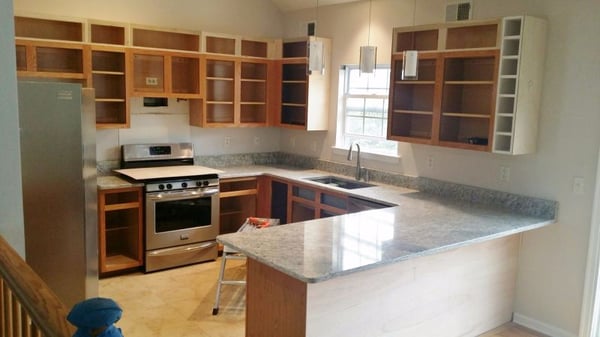
Maria and Tom in Austin, Texas had solid granite countertops they loved, but their cabinets were water-damaged and dated. Instead of a full gut renovation, they chose a professional team to replace only the cabinet boxes. The installers used heavy-duty bracing to support the granite, carefully removed the old cabinets, and slid in new plywood boxes.
They finished the project in four days, with no damage to the stone. The total cost was $7,000—about half the price of a full kitchen remodel. Maria says the biggest surprise was how much time went into measuring and supporting the stone, but the results were worth it.
Credit: blog.kitchenmagic.com
Is This Project Right For You?
Replacing kitchen cabinets without removing the countertop is not a simple weekend project, but it’s a smart way to save money and reduce waste if you follow best practices. If your countertop is in great shape, and you’re ready for a new look, this method can give you a fresh kitchen with less mess and cost.
Be realistic about your skills, your kitchen’s layout, and your countertop’s material. When in doubt, consult with professionals who have experience with this exact process. Careful planning, accurate measurements, and patience are your best tools for a stress-free upgrade.
Frequently Asked Questions
Can I Replace Just Some Cabinets Under My Countertop?
Yes, you can replace only certain cabinets, like the sink base or damaged units, without removing the entire countertop. However, you must support the countertop during the process to avoid cracks. This approach works best if you’re not changing the kitchen’s layout.
What If My New Cabinets Are A Different Height?
Your new cabinets must match the height of the old ones exactly, or the countertop will not sit correctly. Standard base cabinets are usually 34. 5 inches tall, but measure your existing setup. If you change the height, you’ll have gaps or uneven surfaces.
How Do I Know If My Countertop Can Handle The Process?
Check the material and installation method. Stone and tile countertops require continuous support and careful handling. Laminate is more forgiving. If you’re not sure, have a professional evaluate your kitchen before starting.
Is Cabinet Refacing As Good As Full Replacement?
Refacing is an excellent option if your cabinet boxes are solid and you mainly want a style update. It’s less invasive and cheaper but doesn’t fix structural or layout problems. If your cabinets are damaged, a full replacement is better.
Do I Need A Permit To Replace Kitchen Cabinets?
In many areas, replacing cabinets does not require a permit, but plumbing or electrical work often does. Always check your local building codes before starting. If you hire a contractor, they should handle permits for you.
Upgrading your kitchen by replacing cabinets without removing your countertop is a smart, sustainable choice when done right. With careful planning and the right help, you can achieve a fresh look and better function—without the headache of a full remodel.