
Buying or making a sofa cover sounds simple until you realize every couch is a different size and shape. One mistake in measuring can lead to a loose, baggy fit or a cover that simply won’t stretch over your favorite furniture. If you want your sofa cover to look neat, protect your couch, and last for years, taking accurate measurements is the most important step. But how do you do that, especially if your sofa has curves, arms, or a sectional design? Measuring a sofa for a cover isn’t just about grabbing a tape measure. It’s about understanding the details of your couch and the way covers are designed to fit.
This guide explains, step by step, how to measure a sofa for a cover, no matter its style. You’ll learn the must-know basics, common mistakes that waste money, and practical tips even many experienced buyers overlook. Whether you want a tight slipcover, a loose drape, or a custom design, you’ll find everything you need to measure with confidence—and get a cover that fits like it was made for your home.
Why Accurate Sofa Measurements Matter
Choosing the right sofa cover is impossible without the right measurements. Many people think “close enough” is good enough, but this often leads to disappointment. A sofa cover that’s too small won’t stretch or may tear. If it’s too large, it will bunch up, slide off, and look messy. Worse, an ill-fitting cover can shift when you sit, making your couch uncomfortable.
Accurate measurements also save you money. Custom covers are not returnable in most cases, and even ready-made covers usually have strict return policies. Taking time to measure carefully means you buy the right size the first time, avoiding expensive mistakes.
Plus, correct sizing helps extend the life of both your sofa and your cover by reducing stress on seams and fabric.
Types Of Sofa Covers And How They Affect Measurement
Before you measure, it’s essential to know the type of cover you want. Different styles fit sofas in different ways, and each style requires a slightly different approach.
1. Stretch/fitted Slipcovers
These covers are made from elastic materials like spandex or polyester blends. They are designed to fit snugly. For stretch covers, precise measurements are less critical, but you still need to stay within the recommended size range.
2. Loose/relaxed Covers
Loose covers drape over the sofa and are usually made of cotton or linen. These require more exact measurements, especially for length, width, and drop (the part hanging down).
3. Custom-made Covers
If you’re ordering a cover made to your sofa’s exact dimensions, every detail matters: arms, cushions, corners, and even the shape of the back.
4. Sectional Covers
Sectional sofas need covers for each piece. Measurements for sectionals are more complex and must be done for each section (corner, chaise, armless, etc. ).
Non-obvious tip: Covers with piping or special seams need even more precise measurements. Don’t assume a “universal” cover will hide all design details.
What You Need Before Measuring
Having the right tools and setup can make measuring your sofa much easier:
- Flexible measuring tape: A soft tape measure (not a metal one) works best.
- Notepad and pen: Record every measurement immediately.
- Helper: For large sofas, it’s easier with two people.
- Camera or phone: Take photos of your sofa from several angles for reference.
- Diagram or sketch: Draw a simple outline of your sofa and label each part.
Pro insight: Double-check your tape for accuracy. Some old measuring tapes stretch, giving wrong results.
Understanding Your Sofa’s Anatomy
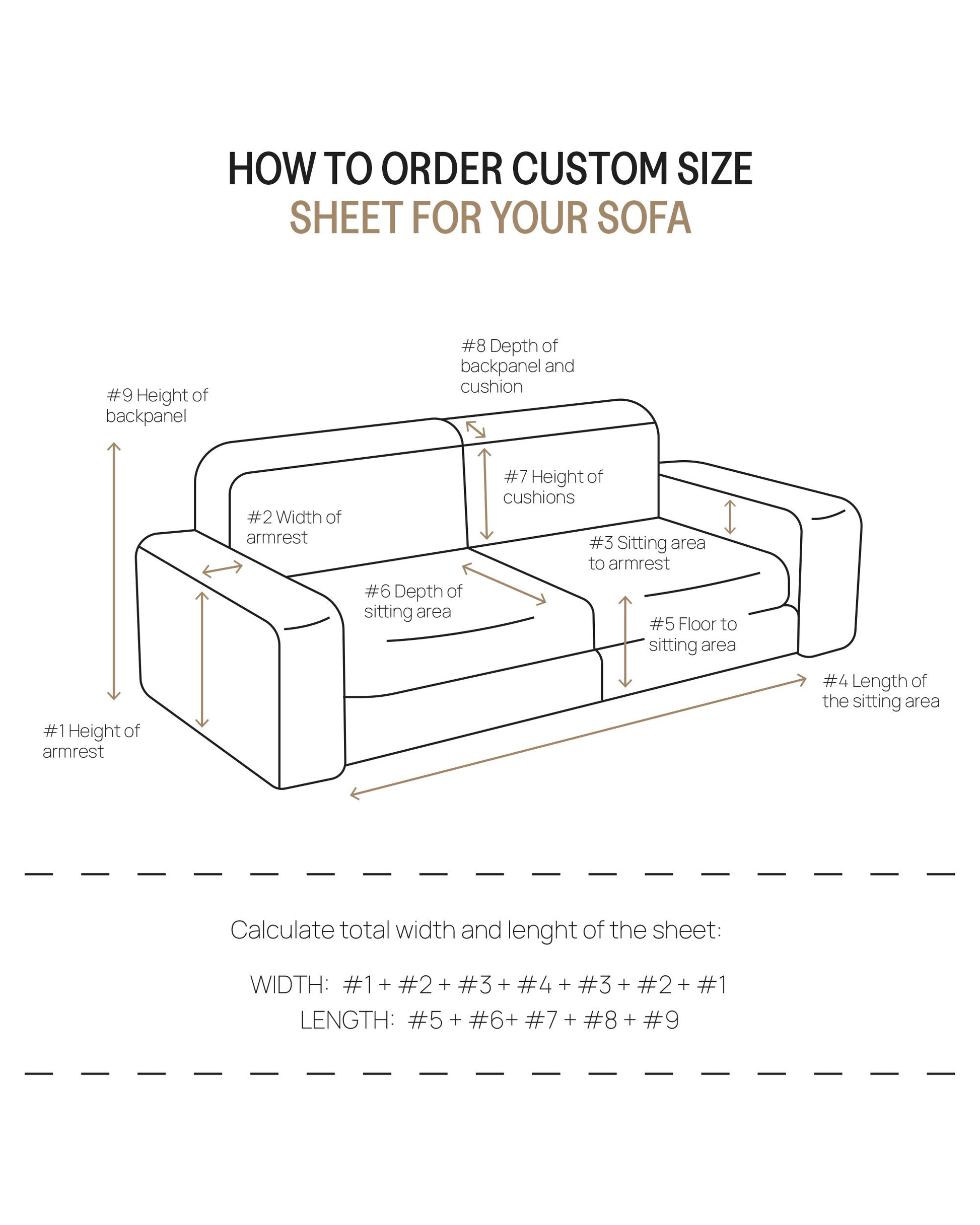
Every sofa is different, but most have similar parts you’ll need to measure:
- Total width (arm to arm)
- Seat width (inside arms)
- Depth (front to back)
- Seat depth (front to cushion back)
- Arm height (floor to top of arm)
- Arm width
- Back height (floor to top of back)
- Cushion thickness
- Base height (floor to sofa base)
Not all measurements are needed for every cover, but knowing each part ensures you don’t miss any details.
Step-by-step: How To Measure A Standard Sofa For A Cover
Let’s break down the process for a typical three-seat sofa.
1. Measure The Total Width
Place your tape measure at the outer edge of one arm, stretch it across the seat and cushions, and end at the outer edge of the other arm. This is the most important measurement for most covers. Record the number.
2. Measure The Seat Width
Measure from the inside edge of one arm to the inside edge of the other arm. This is important for fitted covers.
3. Measure The Depth
Hold your tape at the front edge of the seat and pull it straight back to the furthest point of the sofa’s back (not the cushion, the frame). This tells you how deep the cover must be.
4. Measure The Seat Depth
Measure from the front of the seat cushion to where it meets the backrest.
5. Measure The Arm Height And Width
For the arm height, go from the floor to the top of the arm (if it’s curved, measure at the highest point). For the arm width, measure across the widest point.
6. Measure The Back Height
Start at the floor, behind the sofa, and measure to the highest point of the backrest.
7. Measure Cushion Thickness
If your cushions are thick, measure from the top to the bottom of the cushion.
8. Measure The Base Height
Measure from the floor to the bottom edge of the sofa’s frame.
Common mistake: People often skip the arms and back, thinking the cover will just stretch. In reality, these areas are where tightness or looseness is most visible.
How To Measure For Different Sofa Styles
Not all sofas are created equal. Here’s how to adapt measurements for common styles.
Measuring A Sectional Sofa
Sectionals can be L-shaped, U-shaped, or modular. Here’s how to approach them:
- Break the sectional into pieces. Measure each part as a separate sofa: Chaise, corner, armless, etc.
- Measure the connection points. Note the width and depth of each connecting area.
- Record overall length and depth for each section.
Practical tip: Draw a diagram of your sectional and label each piece as you measure.
Measuring A Recliner Sofa
For a sofa with a reclining feature:
- Measure with the recliner in the closed position for the standard cover.
- If the cover must allow for reclining, also measure the full extension length (from the back when fully reclined to the footrest tip).
- Note any handles, levers, or buttons that stick out.
Measuring A Sofa Bed
Sofa beds (pull-out couches) are usually measured in their closed position. If you want a cover that fits when the bed is open, measure both:
- Closed: Measure like a standard sofa.
- Open: Measure from the back to the end of the extended bed.
Measuring Curved Or Chesterfield Sofas
Curved sofas or those with rolled arms (like Chesterfields) require extra attention:
- Follow the curve of the back and arms with your tape, not just a straight line.
- Measure the widest points for both width and depth.
- Record the height at the tallest part.
Non-obvious insight: For curved backs, add 1-2 inches to your measurement for a relaxed cover, or subtract 1 inch for a tight, fitted cover.
Special Considerations For Measuring
1. Removable Vs. Fixed Cushions
If your sofa has removable cushions, you may want a cover that fits each cushion separately. Measure each cushion’s width, depth, and thickness. For fixed cushions, measure as one piece.
2. Skirted Sofas
Skirted sofas have fabric hanging down at the base. Decide if you want the cover to go over or under the skirt. If over, include the skirt in the height measurement.
3. High Back Sofas
For sofas with high backs, measure to the tallest point—even if it’s curved or angled.
4. Sofas With Pillows
If your sofa has attached pillows on the back, press them down gently and measure to the top. For a loose cover, add an inch; for a tight fit, measure as is.
5. Sofas With Built-in Storage Or Features
If there are trays, cup holders, or pull-out drawers, measure around these and note their position for custom covers.
How To Record And Organize Measurements
Staying organized is key to getting the perfect fit. Here’s a simple way to lay out your notes:
| Measurement | Start Point | End Point | Result (inches) |
|---|---|---|---|
| Total Width | Outer arm | Outer arm | — |
| Seat Width | Inner arm | Inner arm | — |
| Depth | Front seat | Back frame | — |
| Back Height | Floor | Top of back | — |
Fill in the blanks with your numbers as you go.
How To Measure For A One-piece Vs. Multiple-piece Cover
Some covers are made as a single piece, others as several (e. g. , one piece for the frame, separate for cushions and arms).
- One-piece covers: Measure the sofa as a whole.
- Multiple-piece covers: Measure each part separately (back, seat, arms, cushions).
Pro tip: If you’re not sure which type you need, contact the manufacturer with your measurements before buying.
How Much Extra To Allow
Many people ask: Should I add extra inches “just in case”? The answer depends on the type of cover:
- For stretchy covers, stay within the manufacturer’s size range.
- For non-stretchy covers, add 1-2 inches to width and depth for a relaxed fit.
- For custom covers, give exact measurements—let the maker add allowances.
Beginner mistake: Adding too much extra leads to bagginess. Trust the size chart or ask the seller for advice.
Credit: magiclinen.com
Measuring For Cover Drop Length
The drop length is how far the cover hangs down from the seat or arm to the floor. Some people want a cover that touches the floor; others prefer a shorter drop.
- Measure from the top of the seat/arm to the floor.
- Decide if you want a full-length cover or one that leaves the legs visible.
Pro tip: For families with pets or kids, a full drop offers more protection.
Measuring For T-cushion And L-shaped Sofas
If your sofa has T-cushions (where the cushion sticks out in front of the arm), measure the longest part of the cushion, including the overhang. For L-shaped sofas, measure each part as a separate rectangle.
Common Measuring Mistakes (and How To Avoid Them)
- Measuring the cushions only: Always measure the sofa frame, not just the cushions.
- Not measuring both arms: Some sofas have arms of different shapes or sizes.
- Forgetting the back height: Even if it sits against a wall, the cover must fit.
- Rounding up too much: Stay as close to the real number as possible.
- Ignoring non-removable parts: Handles, buttons, or attached trays must be included.
Real-world Example: Measuring A Three-seat Sofa
Let’s say you have a standard three-seat couch with rolled arms. Here’s how you’d measure:
- Total width (outer arm to outer arm): 86 inches
- Seat width (inner arm to inner arm): 72 inches
- Depth (front to back): 36 inches
- Seat depth: 22 inches
- Arm height: 25 inches
- Arm width: 10 inches
- Back height: 34 inches
- Cushion thickness: 6 inches
With these numbers, you can check manufacturer size charts or order a custom cover.
Size Charts: How To Use Them
Most sofa cover brands offer a size chart. Here’s how to match your measurements:
| Your Sofa Width | Recommended Cover Size | Fits Seat Width |
|---|---|---|
| 60-75 inches | Medium | 50-65 inches |
| 76-90 inches | Large | 66-80 inches |
| 91-110 inches | Extra Large | 81-100 inches |
Always choose the size that puts your measurements near the middle of the range.
Measuring For Special Materials
Different fabrics behave differently. Stretchy covers need less precision, but cotton, linen, or canvas covers need exact numbers.
Non-obvious insight: Some materials shrink after washing. If your cover is 100% cotton, ask if it’s pre-shrunk.
Diy Vs. Professional Measuring
Should you measure yourself or hire a pro? For most standard sofas, DIY is fine. For unusual shapes, expensive custom covers, or antique couches, consider a professional upholsterer.
Practical example: If your sofa has many angles, curves, or features, a pro can ensure a perfect fit and avoid costly mistakes.
Measuring For Pet- And Kid-friendly Covers
If you’re buying a cover mainly to protect against kids or pets:
- Measure with some extra “tuck-in” room, especially for loose covers.
- Look for covers with elastic bands or straps.
- For covers with waterproof layers, check the thickness, as this can affect fit.

Credit: crelocouchcovers.co.za
How To Measure For Diy Sofa Covers
If you’re making a cover yourself:
- Measure every part, including under the cushions.
- Add seam allowances (usually 1-2 inches per seam).
- Note the direction of the fabric’s stretch or pattern.
- Mark special features (zippers, ties, buttons) in your notes.
Pro tip: Create a paper or fabric template before cutting expensive fabric.
How To Check Your Measurements
- Double-check all numbers.
- Ask a friend to check your tape measure.
- Compare with the sofa’s official dimensions (if you have them).
- Take photos of your tape in place for future reference.
Beginner mistake: Writing down numbers in centimeters when the cover is sized in inches. Stick to one system.
How To Communicate Measurements For Custom Orders
If you order a custom cover, send:
- A full list of all measurements
- Photos from multiple angles
- Any diagrams or sketches
- Notes about features (recliners, storage, etc.)
Practical example: “My sofa is 86 inches wide from arm to arm, 36 inches deep, and 34 inches high at the back. The arms are rounded, 10 inches wide, and 25 inches high. I want the cover to hang to the floor.”
Comparison: Measuring Standard Vs. Sectional Vs. Recliner Sofas
Here’s a quick reference for the differences:
| Sofa Type | Key Measurements | Special Notes |
|---|---|---|
| Standard | Width, Depth, Height, Arms | Usually one piece |
| Sectional | Each section: Width, Depth, Connection points | Measure all pieces separately |
| Recliner | Closed and open length, Width, Height | Include handles and full extension |
Troubleshooting: What If My Sofa Is Between Sizes?
If your sofa measurements fall between two cover sizes:
- For stretch covers, choose the smaller size for a snug fit.
- For non-stretch covers, choose the larger size and tuck in the excess.
- For custom orders, give your exact numbers and ask for advice.
Expert tip: Never try to force a small cover to fit; seams can rip or fabric may tear.
When To Consider Professional Help
While most people can measure a sofa at home, there are situations where it’s better to call in a pro:
- Antique or high-value sofas
- Unusual shapes (round, curved, deep-buttoned)
- Sofas with built-in electronics or moving parts
- If you have tried and failed to get a good fit with ready-made covers
A professional can also help with fabric selection and fitting.

Credit: uk.funnyfuzzy.com
Where To Find More Information
If you want even more technical detail, the Wikipedia Slipcover page explains the history and construction of sofa covers.
Final Tips For Measuring Sofa Covers
- Always measure twice to avoid mistakes.
- Write down every number as soon as you take it.
- Take photos for backup, especially if ordering online.
- If in doubt, contact the manufacturer with your questions.
- Remember: A great fit starts with great measurements.
Getting your sofa cover measurements right might take a few extra minutes, but it saves you time, money, and frustration in the long run. With these steps, your new cover will look and feel just right—protecting your sofa and giving your space a fresh look.
Frequently Asked Questions
How Do I Measure A Curved Or Round Sofa For A Cover?
Start by following the curve with a flexible tape measure. Measure the widest points for both width and depth, and the tallest point for height. For round sofas, add 1-2 inches if you want a relaxed cover. Take photos to help a custom cover maker understand the shape.
What If My Sofa Is L-shaped Or A Modular Sectional?
Break the sofa into its separate sections. Measure the width, depth, and height of each piece independently. Also measure the connection points where sections join. A diagram with labels helps avoid confusion when ordering covers.
Should I Add Extra Inches To My Measurements For Shrinkage?
For stretch or pre-shrunk covers, don’t add extra inches. For 100% cotton or linen covers that might shrink after washing, add 1-2 inches to each measurement. Check if the fabric is pre-washed or pre-shrunk.
Can I Use The Manufacturer’s Dimensions Instead Of Measuring Myself?
It’s better to measure your own sofa. Manufacturer specs may not include arms, legs, or unique features. Your sofa may also have changed shape over time (e. g. , sagging cushions). Always confirm with your own tape measure.
What’s The Most Common Mistake When Measuring For A Sofa Cover?
The most common mistake is measuring only the seat or cushions and forgetting the arms and back. Another is rounding measurements up or down too much. Always measure the full frame and write down exact numbers for the best fit.
With these detailed steps and tips, you’ll get accurate sofa cover measurements every time—leading to a cover that looks great and protects your furniture for years.