
French doors are one of the most attractive ways to bring light and elegance into your home. These double doors, usually made of glass panels, can open up a room and give you a beautiful view of your backyard or patio. But before you enjoy the charm of new French doors, it’s crucial to get one thing exactly right: the measurements. If you measure incorrectly, you can end up with doors that don’t fit, gaps that cause drafts, or even extra costs for adjustments. This guide will walk you through how to measure for French doors, step by step, with practical tips, real-world examples, and detailed answers to common questions. Whether you’re a homeowner, a contractor, or a DIY enthusiast, these instructions will help you avoid mistakes and achieve a perfect fit.
Understanding French Doors
Before you grab your tape measure, it helps to know what makes French doors unique. French doors are typically a pair of doors with multiple glass panels. They can swing inward or outward and may be installed as an entryway to a patio, a deck, or even inside your house.
French doors come in standard sizes, but many homes have custom openings. Also, different styles and frame types can affect the final size you need. Some doors include sidelights (fixed glass panels on the side), and some do not. Knowing exactly what you want will help you measure correctly.
Why Accurate Measurement Matters
Small measurement errors can create big problems. For example, a door that is too wide may not fit in the opening, while a door that is too narrow can leave unsightly gaps. Poor fit can also mean:
- Energy loss from drafts
- Security risks due to weak installation
- Difficult operation (doors that stick or won’t close fully)
- Increased installation costs
A few extra minutes spent measuring carefully can save you hours and money later.
Tools And Materials You’ll Need
To measure for French doors, gather these items:
- Measuring tape (preferably at least 25 feet)
- Level
- Pencil and paper
- Step stool or ladder (if the opening is tall)
- Camera or smartphone (to take pictures for reference)
- Helper (optional, but can make the process easier)
Having these tools nearby will make your work faster and more accurate.
Deciding On Door Configuration
Not all French doors are the same. Before you measure, decide on the door type:
- In-swing vs. out-swing: Do you want the doors to open into the room or out to the patio?
- Pre-hung vs. slab: A pre-hung door comes with its own frame; a slab is just the door panels.
- With or without sidelights: Will you have extra glass panels beside the doors?
- Standard or custom size: Are you fitting a typical opening or something unique?
Knowing these details affects where and how you measure.
Measuring The Door Opening: Step-by-step
Let’s get into the main steps. The process may seem detailed, but every measurement matters. These steps focus on measuring for a pre-hung French door (with a frame), which is the most common installation.
Step 1: Measure The Width
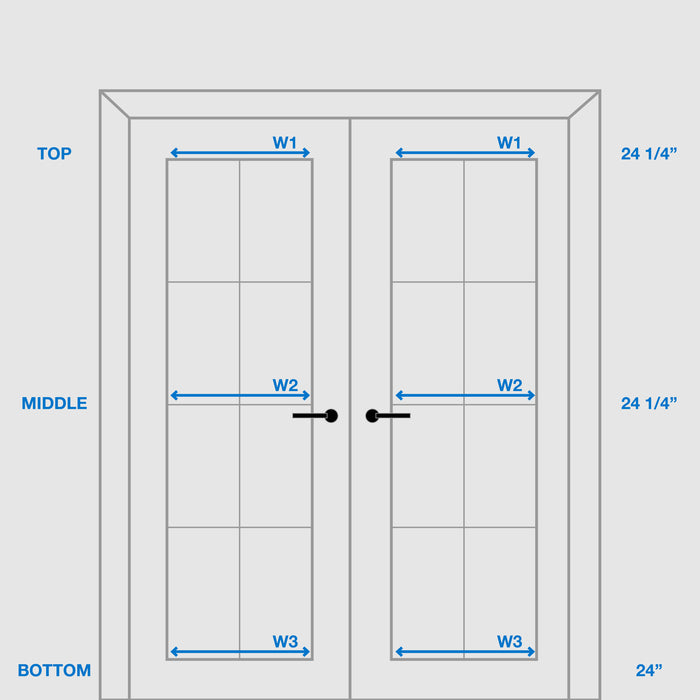
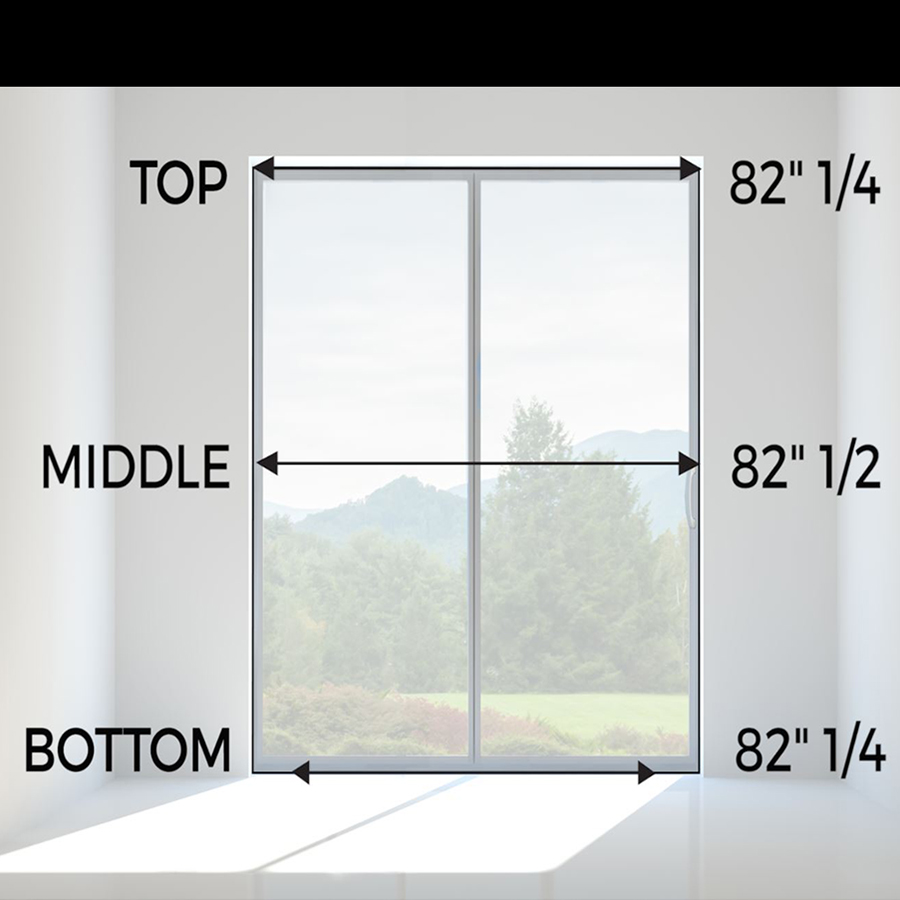
- Measure at three points: Use your measuring tape to check the width at the top, middle, and bottom of the door opening.
- Record each measurement. Openings are rarely perfectly square, so don’t skip any point.
- Use the smallest measurement. This ensures the new doors will fit the narrowest part.
Example:
Top Width: 62 Inches
Middle Width: 62.5 Inches
Bottom Width: 61.75 Inches
Use 61. 75 inches as the rough opening width.
Step 2: Measure The Height
- Measure from the floor to the top of the opening on the left, center, and right sides.
- Record all three.
- Use the shortest measurement. Floors and headers can be uneven.
Example:
Left: 81 Inches
Center: 80.75 Inches
Right: 80.5 Inches
Use 80. 5 inches as the rough opening height.
Step 3: Measure The Depth (jamb)
- Measure the wall thickness from the inside face to the outside face (exclude any trim).
- Standard walls are usually 4-9/16″ or 6-9/16″, but older homes may vary.
Tip: If you have tile, stone, or brick around the opening, measure to the actual wall structure, not just the trim or finishes.
Step 4: Check For Squareness
Use your level and measuring tape to check:
- Diagonal measurements: Measure from the top left corner to the bottom right, and from the top right to the bottom left. If the measurements are close (within 1/4 inch), your opening is square.
- Wall plumb: Use a level on both sides of the opening to see if the wall is straight up and down.
If the opening is out of square, you may need to adjust the installation later or order custom doors.
Step 5: Note Obstructions
Look around the opening for anything that could block the doors:
- Light switches or outlets
- Baseboard heaters
- Security systems
- Window sills
- Overhanging trim
Write these down and take photos. They may affect the installation or door swing.
Measuring For Sidelights
If your design includes sidelights, measure their space separately:
- Measure the width of each sidelight opening from the edge to the door.
- Measure the height, just as you did for the main opening.
- Note if the sidelights are equal in size or different (some homes have one wide and one narrow).
Non-obvious insight: Sidelights often require extra framing support. Make sure the rough opening is strong enough to hold the additional glass, especially in older homes.
Measuring For Replacement French Doors
If you’re replacing existing French doors and not changing the opening size, you still need accurate measurements.
- Remove interior trim if possible. This lets you see the rough opening, not just the door slab.
- Measure the existing door slab width and height.
- Check frame condition. If the old frame is damaged, you’ll need to measure for a pre-hung door.
Tip: Many people forget to measure the *thickness* of the current door slab. Standard is 1-3/4″, but some older doors are thinner or thicker.
Credit: www.beasenhome.com
Measuring For New Construction
If you’re installing French doors in a brand new wall, use your construction plans or frame the opening to standard rough opening sizes.
Here’s a comparison of common standard French door sizes and the required rough openings:
| Door Size (WxH, inches) | Rough Opening (WxH, inches) |
|---|---|
| 60 x 80 | 62 x 82 |
| 64 x 80 | 66 x 82 |
| 72 x 80 | 74 x 82 |
| 96 x 80 | 98 x 82 |
Always confirm with the door manufacturer’s specifications before framing.
Measuring For Interior Vs Exterior French Doors
The same measurement steps apply for both interior and exterior French doors, but there are key differences to keep in mind.
Interior French Doors
- Usually lighter, with thinner frames
- May not need weatherproofing
- Open into rooms, not outdoors
- Sidelights are less common
Exterior French Doors
- Heavier, with thicker frames
- Need tight seals for weather and security
- Often have more complex thresholds
- Sidelights and transoms are more common
Practical tip: For exterior doors, always measure for the threshold (bottom step or plate). Skipping this can lead to poor weather sealing.
Measuring For Custom Openings
If your home is older or has a non-standard opening, you may need custom French doors.
- Measure the opening exactly as described above.
- Take extra care with diagonals and wall thickness.
- Send your measurements to the manufacturer. Many companies can build to your exact size.
Non-obvious insight: Custom doors usually take longer to arrive and cost more. Double-check your numbers before ordering, as custom doors are rarely returnable.
Common Measurement Mistakes (and How To Avoid Them)
Even experienced DIYers can make mistakes. Here are the most common errors:
- Measuring only at one point: Always measure width and height at three points and use the smallest number.
- Forgetting the frame: When buying a pre-hung door, measure the rough opening—not just the old door slab.
- Ignoring wall thickness: Jamb depth must match your wall, or the door will look unfinished.
- Not checking for square: Out-of-square openings can cause big headaches later.
- Overlooking obstructions: Outlets, heaters, and trim can block the door swing.
- Measuring with trim on: Always remove at least one piece of trim to see the true opening.

Credit: www.chairup.com
How To Record And Communicate Your Measurements
Getting the right measurements is half the job; sharing them clearly is the other half.
- Write down each measurement in inches (not feet and inches).
- Take photos of the opening with a tape measure visible.
- Label each measurement: “Top width = 62 inches,” “Left height = 80.5 inches,” etc.
- If you email or share with a door supplier, include details about in-swing/out-swing, pre-hung/slab, and whether you want sidelights.
Here’s a sample measurement record:
| Measurement Point | Width (inches) | Height (inches) |
|---|---|---|
| Top | 61.75 | 80.75 |
| Middle | 62.00 | 80.50 |
| Bottom | 61.50 | 80.25 |
Special Cases: Measuring For Arched Or Transom French Doors
Some French doors include an arched top or a transom window above the door. These require extra care.
- For arches, measure the width at the base and the height at the highest point.
- For transoms, measure the height of the transom opening separately.
- Send a sketch or photo to the door supplier.
Experience-based tip: Arched doors often need custom framing and extra lead time. Don’t assume a standard door will fit.
Practical Examples
Let’s walk through two real-world cases:
Example 1: Replacing Old Exterior French Doors
Sarah lives in a 1950s house with an old set of French doors leading to her patio. The doors are drafty and hard to open. She wants to replace them with new, energy-efficient ones.
- Sarah removes the inside trim to measure the rough opening.
- She measures:
- Top width: 72 inches
- Middle width: 71.75 inches
- Bottom width: 71.5 inches
- Left height: 80 inches
- Center height: 80.25 inches
- Right height: 80 inches
- Wall thickness: 5 inches
- She uses the smallest width (71.5″) and height (80″) for ordering.
- She sends her measurements and a photo to the supplier, asking for a pre-hung, out-swing, exterior French door with a 5-inch jamb.
Example 2: Measuring For New Interior French Doors
Mike is building a new home office and wants to add French doors between the office and the hallway.
- The wall studs are already in place.
- He measures the framed opening:
- Width: 60 inches
- Height: 82 inches
- Wall thickness: 4-9/16 inches
- He checks the door manufacturer’s rough opening guide and confirms that a 60×80 inch door will fit.
- Mike notes there are no obstructions and the wall is plumb.
Additional Tips For A Perfect Fit
- Always measure twice. Mistakes are easier to fix on paper.
- Ask for help. Measuring large openings is easier with two people.
- Consider door hardware. Knobs and locks sometimes need extra space on the frame.
- Order a door sweep or threshold for exterior doors to keep out drafts.
- Don’t forget about flooring. New tile or carpet can change the opening height.
Credit: www.selectblinds.com
What To Do If Your Opening Is Not Square
Most homes settle over time, leading to non-square openings. If your measurements show more than a 1/4-inch difference corner to corner, you have options:
- Order a slightly smaller door and use shims to install it level.
- Have a carpenter adjust the opening before installing.
- Use wider trim to cover any gaps from an uneven frame.
Comparing Pre-hung Vs. Slab French Doors
Which should you choose? Here’s a quick comparison:
| Feature | Pre-Hung Door | Slab Door |
|---|---|---|
| Includes Frame | Yes | No |
| Easier to Install | Yes | No |
| Best for New Openings | Yes | No |
| Best for Replacing Same Size Door | No | Yes |
| Custom Sizing Possible | Yes | Yes |
If you’re not sure, talk with your supplier. Most homeowners choose pre-hung for exterior doors and slab for interior replacements.
How To Measure For French Doors: Quick Reference
- Measure width at top, middle, bottom—use the smallest
- Measure height at left, center, right—use the smallest
- Measure wall thickness
- Check for squareness and obstructions
- Record everything and take photos
- Confirm your door configuration (in-swing/out-swing, pre-hung/slab, sidelights)
- Double-check before ordering
When To Call A Professional
If your opening is very out-of-square, includes arches or transoms, or has structural damage, it’s smart to call a carpenter or door installer. They have the tools and experience to handle tricky situations and can help avoid expensive mistakes.
Additional Resources
For more detailed door sizing standards, you can visit the Wikipedia page on French doors.
Frequently Asked Questions
How Do I Measure For French Doors If My Opening Is Not Perfectly Square?
If your opening isn’t square, always use the smallest width and height measurements. This ensures the door will fit the tightest spot. You can use shims during installation to level the frame and fill small gaps. For very uneven openings, consider hiring a professional to adjust the framing.
Can I Measure For French Doors Without Removing The Trim?
It’s possible, but not ideal. Measuring with the trim on gives you the finished opening, not the rough opening. For the most accurate results, remove at least one piece of trim to measure the actual frame. If you can’t remove the trim, subtract about 1/2 inch from your width and height as an estimate, but be aware this may not be perfect.
What’s The Difference Between Measuring For Pre-hung And Slab French Doors?
When measuring for a pre-hung door, you must measure the rough opening (the space inside the wall studs, after removing trim). For a slab door, you measure the existing door panel’s width, height, and thickness. Pre-hung doors are easier for new installations, while slab doors are often used for replacements.
How Much Bigger Should The Rough Opening Be Than The French Door?
The rough opening should be about 2 inches wider and 2 inches taller than the actual door size. This extra space allows for the frame, shims, and adjustment during installation. Always check the manufacturer’s instructions, as requirements can vary.
Are There Standard French Door Sizes, Or Do I Need Custom Doors?
There are common standard sizes (like 60×80, 64×80, 72×80 inches), but many homes have unique openings, especially older houses. Measure carefully and check with your supplier. If your opening doesn’t match a standard size, custom doors are available but cost more and require precise measurements.
French doors can transform the look and feel of your home, but they’ll only work as intended if you measure with care. Take your time, double-check your numbers, and don’t be afraid to ask for help if you need it.
With the right measurements, your new French doors will fit perfectly and add beauty for years to come.